Showing posts with label Winchester. Show all posts

Thursday, 3 April 2014

Caer Gwinntguic

A very early fifth century British kingdom, Caer Gwinntguic evolved from the pre-Roman territory of the Belgae tribe. Centred on the Roman town of Venta Belgarum, the kingdom was tasked with defending the westernmost section of the Saxon Shore. In the face of increasing barbarian raids, laeti from North Germany, most likely Saxons, were settled along the south coast. Meonware Jutes also settled along the coast, potentially threatening the kingdom’s southern borders, but peaceful relations appear to have been quickly established. Of greater concern was Aelle and the Suth Seaxe who had landed on the south coast in 477.

From its very beginnings, Caer Gwinntguic was on a defensive footing, likely due to the collapse of Rhegin to the southeast, the expansion of the Suth Seaxe and the emerging West Seaxe kingdom under Cerdic. In the mid-fifth century, there was a widespread laeti revolt, triggered by a plague that swept across southern Britain and a vicious power struggle within the British administration. However, it seems that many of the laeti of Caer Gwinntguic remained loyal and fought alongside their Romano-British neighbours right up until the kingdom’s dying days in the late sixth century. As a result, the archaeology of Caer Gwinntguic reveals a blend of cultures and people, perhaps best illustrated by the kingdom’s name itself; ‘Gwinntguic’ is likely a Saxon corruption of a Celtic name which was later adopted by the British.

In 508, the Saxon and Romano-British warriors of Caer Gwinntguic were led by a chief by the name of Natanlaod to meet the West Seaxe in battle somewhere near Southampton Water. Cerdic’s West Seaxe took victory and, as a result, Caer Gwinntguic was completely isolated from the south coast it was supposed to protect. Fifty years later, the kingdom fell to the West Seaxe, leaving its northern neighbour, Caer Celemion, exposed and vulnerable. The city of Venta Belgarum was not fully abandoned, however, and it is likely that a small number of surviving Saxon laeti and Romano-Britons eked out a living in the ruins. Perhaps because it was not fully abandoned, Venta Belgarum would later be revived as Wintanceastre, the capital of Wessex.

Tuesday, 1 April 2014

Venta Belgarum

Established in 70 AD on the site of an abandoned Iron Age hill fort, Venta Belgarum was the civitas of the Celtic Belgae tribe whose territory covered much of modern-day Hampshire. Venta Belgarum was a thriving and prosperous Romano-British town.  A defensive earth bank and ditch encircled the city by the second century, and stone city walls were erected a century later. Excavations have shown that Venta Belgarum had many fine Roman townhouses complete with mosaics, large public buildings and temples dedicated to the Roman gods Jupiter, Juno and Minerva as well as the Celtic horse goddess, Epona. Outside of the city walls were extensive suburbs and two large Romano-British cemeteries to the north and east.

Mosaic floor from a nearby Roman villa
Venta Belgarum did not escape the general decline suffered by Roman Britain in the fourth century. Houses started to fall into disrepair and the drainage system collapsed.  Testament to the increasing threat of raids by Germanic war bands, the city’s defences were strengthened and there is archaeological evidence of laeti, South German mercenaries who helped defend Venta Belgarum in return for land outside the city.
By the early fifth century, Venta Belgarum had become the regional capital of Caer Gwinntguic, a sub-Roman British kingdom tasked with defending the westernmost portion of the Saxon Shore. The 420s and 430s saw a second settlement of laeti, this time from North Germany and almost certainly Saxons. Jutish settlement on the eastern side of Southampton Water posed a potential threat but peaceful relations were quickly established, possibly due to the newcomers’ integration with long-settled laeti.

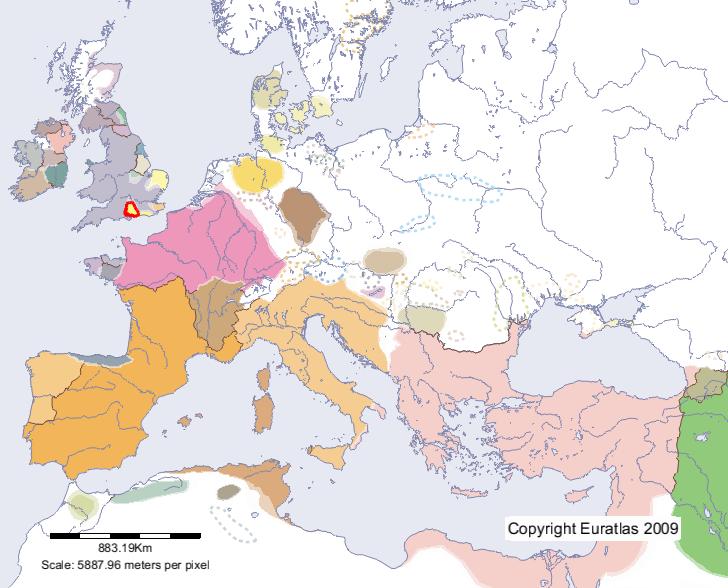
Map of Europe in 500 AD. Venta Belgarum / Caer Gwinntguic is outlined in red.
By 477, the arrival of Saxon settlers under Aelle at Selsey in modern day West Sussex had largely cut off Venta Belgarum from the south coast. The city’s population had dwindled and economic activity had all but ceased. Over the next fifty years, the few inhabitants of Venta Belgarum must have developed a siege-like mentality in the face of Saxon encroachment from the east. The city’s south gate was blocked in two stages, probably in response to the founding of a nascent West Saxon kingdom under Cerdic, an act that likely forced Cerdic to advance instead towards the less well-defended West Country.

By the early 6th century, Venta Belgarum was very isolated indeed. Rhegin to the south-east had fallen to Aelle of the Suth Seaxe and it was cut off from Dumnonia in the west. The remaining population was likely made up of equal amounts of Romano-Britons and Saxon laeti who, having been settled in Britain for several generations, had more in common with the native population than the invaders.

In 508, the Romano-Britons of Caer Gwinntguic were defeated in battle by the West Seaxe under Cerdic and became completely cut off from the south coast. Fifty years later the kingdom collapsed and the city itself fell to the West Seaxe. The population dwindled even further but it's thought that Venta Belgarum was not fully abandoned. The few Saxon descendents of long-ago laeti probably remained, as did any surviving Romano-Britons. Probably because the city was never fully abandoned, it was revived in the late 6th century and became known as Wintanceastre, capital of the West Seaxe kingdom.