Showing posts with label Kent. Show all posts

Friday, 27 June 2014

Vortigern

Shrouded in legend, Vortigern is a shadowy and semi-mythical early British leader who existed in the first half of the fifth century. There are no contemporary records that have survived and what little we know of him comes from legend and semi-historical tracts written centuries after his death.

A twelfth century illustration showing Vortigern and Merlin watching two dragons battling beneath the King's castle in Wales.
Vortigern came to power sometime in the early fifth century, possibly as early as 425, or as late as 445. He is remembered in legend as the High-King of Britain, a position he achieved through treachery and murder. However, Gildas, a historian writing in the sixth century, merely writes that Vortigern was one of a council, perhaps a civitas leader or magistrate; less of a high-king and more of a first-among-equals. Of his early leadership, very little is mentioned. Some sources claim that he married Sevira, the daughter of Magnus Maximus and had three sons, named in the Historia Brittonum as Vortimer, Catigern and Pascent. Vortigern may also have been involved in a power struggle with Ambrosius Aurelianus, another powerful Romano-British leader, who he defeated in battle in c.437.

Vortigern is immortalised in legend as the man who, in 446, foolishly and shortsightedly invited the Saxon princes, Hengist and Horsa, to settle in Kent in return for protection. Employing one barbarian tribe to defend against another was a standard Roman practice and it worked. Pict and Scottish raids ceased and, for a while, the Britons and Saxons lived peacefully.  Exactly where the mercenaries settled is uncertain; legend has it that they settled on the Isle of Thanet while Gildas rather vaguely mentions that they settled someone in the east. Some years later, the Saxons revolted. The reasons are unknown. Traditionally, Vortigern, drunk at a celebratory feast, fell deeply in love with Rowena, Hengist’s daughter. He promised Hengist whatever he wanted in exchange for her hand in marriage. The Kingdom of Kent was Hengist’s price and Vortigern agreed. Understandably, it was the British who revolted, overthrew Vortigern and put his eldest son, Vortimer, on the throne and battled against the Saxons. Gildas, on the other hand, writes that the Saxons revolted over a disagreement over payment. Yet another version claims that Hengist, realising how poor the British defences were, decided to take the opportunity and seize Kent for himself.

Vortigern’s last mention in the Anglo-Saxon Chronicle was in 455. It’s likely his kingship effectively ended with the Saxon revolt. Whether he died or disappeared is unknown. Legend says that Vortigern fought alongside his sons and was betrayed yet again at the Night of the Long Knives, a peace conference where the Saxons murdered the British in cold blood and forced Vortigern to surrender the kingdoms of Essex and Sussex in return for his life. Vortigern then fled to his powerbase in Powys where he was killed by Ambrosius Aurelianus. His two eldest sons, Vortimer and Catigern, died fighting the Saxons while his third son, Pascent, is named as an early ancestor of the Kings of Powys. 

Saturday, 3 May 2014

Hengist & Horsa

Hengist and Horsa were two early and semi-historical Anglo-Saxon chieftains who arrived in Britain in the mid-fifth century. After the Roman legions abandoned Britain at the beginning of the fifth century, the island was left vulnerable to invasion. Saxon pirates attacked from the east, the Picts and Scotti poured over Hadrian's Wall and the Irish raided along the west coast. It was not a good time to be Romano-British; cities were sacked and civilians were raped, murdered and enslaved as bands of marauders fought and pillaged their way across Britain.

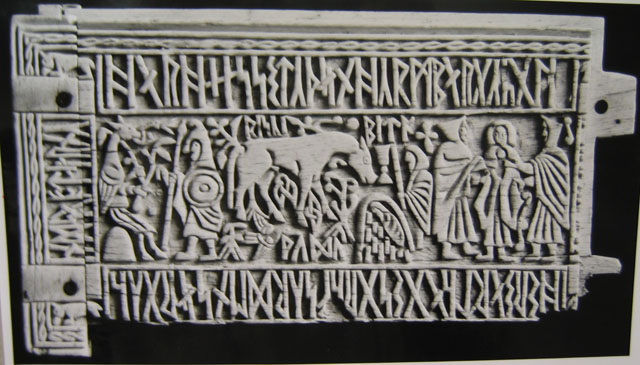
An 8th century carving from Northumbria. The carving shows Hengist (represented as a stallion) grieving over the burial mound of his brother, Horsa. 
By the middle of the fifth century, the Romano-British had had enough. In 449, probably out of desperation, King Vortigern, along with his council of nobles, invited a pair of Saxon princes, Hengist and Horsa, to bring their men over to Britain and fight off the raiders in return for booty and land. This tried and tested Roman strategy worked. The Jutish mercenaries fought off the raiders and settled somewhere, either on the Isle of Thanet (unlikely) or somewhere along the east coast. Some time later Hengist and Horsa began a hostile takeover of Kent. Traditionally, this started with Hengist's daughter, Rowena, seducing the drunken Vortigern at a feast. Madly in love, the king promises Hengist anything he desires in return for his daughter's hand. Hengist's price was Kent. Understandably annoyed, Vortigern's son, Vortimer, deposed his father and raised an army against the Saxons. Historically, its more likely that either there was a disagreement over payment, or, seeing how weak the British defences were, the brothers got greedy.

After a few skirmishes, Hengist's mercenaries defeated Vortimer's men at Aeglesthrep (probably Aylesford). The Anglo-Saxon Chronicle records four battles in all. The results are not recorded but the geographical sequence suggests a Saxon retreat with the last battle fought at Wippedesfloet where, twenty years earlier, the brothers had first landed. Horsa died during this time, presumably in battle, as did Vortimer and his younger brother, Catigern. At some point during this period, the legend goes on to tell of the Night of the Long Knives. Hengist invited Vortigern and his men to make peace but in the midst of the feast, the Saxons massacred the Britons in cold blood. The only survivor was Vortigern himself who, chained and imprisoned, was forced to give up his lands to Hengist. Hengist ruled as King of Kent until his death in 488. His son, Oisc, succeeded to the throne.

As always with early Anglo-Saxon history, its difficult to untangle fact from legend. Hengist and Horsa are probably mythical figures but their story is likely based in fact. A Jutish chief did arrive in Kent in the fifth century. He and his men did serve a British king and they did revolt, fighting several battles against the Britons and gaining the British kingdom of Kent. There is no direct evidence that the Night of the Long Knives happened but the tale is preserved in ancient bardic songs so there may be a kernel of truth in there somewhere.

Friday, 11 April 2014

Durovernum Cantiacorum

Originally an Iron Age hill fort, Durovernum was a town in the Roman province of Britannia which existed for a period of four hundred years from the time of the Roman Conquest until the arrival of Hengist and Horsa in the mid-fifth century.

Durovernum was founded as a Roman fort in 43 AD, very soon after the conquest, to guard a crossing of the River Stour. Military occupation of the site lasted until 60 AD. After demilitarisation, Durovernum became the civitas capital of the Cantii, a Celtic tribe who inhabited most of modern day Kent. The short period of militarisation and the very early date for the founding of Durovernum (one of the earliest in Britain) reflects the largely pro-Roman attitudes found at that time among the Cantii.

With a strategic position on Watling Street, Durovernum was a prosperous and thriving Roman town. As a civitas, the town would have had a forum, a basilica, temples, a theatre and public baths. The exact locations of many of these buildings are unknown, buried as they are under modern day Canterbury. In the late third century, to defend against barbarian raids, stone walls and a large earth bank were constructed around the town.

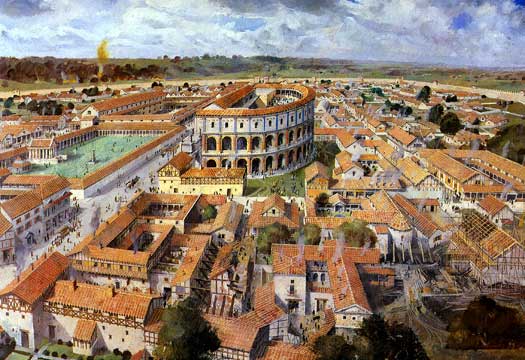
Durovernum Cantiacorum in its Roman heyday...
After the Roman withdrawal in around 410, the Romano-British inhabitants of many civitas capitals in Britain attempted to carry on as normal and Durovernum was no exception. It’s not known if Ceint became a true kingdom in its own right in the early fifth century, or if it was a semi-independent province governed by a Roman-style magistrate. Whichever the case, Ceint’s increasing vulnerability to barbarian raids meant Saxon laeti were quickly hired to protect Durovernum in return for land outside of the city walls.

In the 440s, the Romano-Britons of Ceint were hit by a double-whammy; firstly a plague swept across southern Britain in 446; secondly there was laeti revolt soon after in which many of the Saxon and Jutish mercenaries settled around Ceint joined a Germanic army of invaders led by Hengist and Horsa. Chaos ruled across south-east Britain and Durovernum fell in 457.

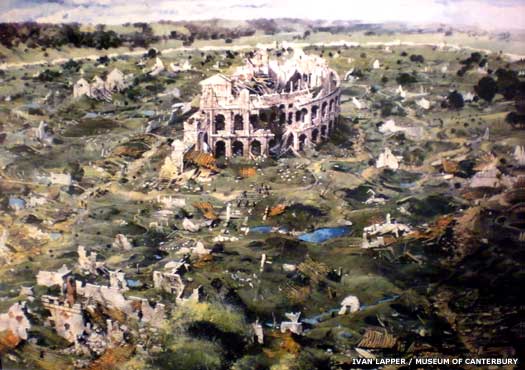
...and Durovernum Cantiacorum in the fifth century. The few inhabitants that remained likely lived in wooden houses among the ruins.
However, despite Hengist’s hostile takeover of Ceint, Durovernum was not completely abandoned. It seems to still have been a sizable settlement although life for the Romano-British inhabitants must have been very different. The Roman buildings and roads quickly fell into disrepair as urban life was abandoned and the people of Durovernum reverted to subsistence farming. The town would later be revived by Jutish settlers who would rename it Cantwaraburh. Over time Cantwaraburh would become Canterbury.