Showing posts with label Strathclyde. Show all posts

Monday, 7 April 2014

Coroticus of Alt Clut (c.410 - c.450)

The first king of Alt Clut, Coroticus was a powerful Celtic monarch who ruled a considerable swathe of southern Scotland from his base on Dumbarton Rock. The history of Alt Clut during the fifth and sixth centuries is murky at best and what little is known comes from Irish and Welsh sources. Because of this, Coroticus is sometimes referred to as Ceretic Guletic, the Welsh version of his name.

The Harleian genealogies list Coroticus as the son of Cynloup, the grandson of Quintillus and the great-grandson of Clemens. The Roman names of his grandfather and great-grandfather suggest that Coroticus descended from Damnonii leaders who, although they lived some way north of Hadrian’s Wall, were Romanised to some extent. However, Coroticus is a British name and it has been suggested that he was named after Caratacus of the Catuvellauni, a then-legendary leader of a British revolt against the Romans.

Not much is known of his reign in the dark days of sub-Roman Britain. Coroticus was almost certainly the Brittonic warrior addressed in a letter written by St. Patrick. In the letter St Patrick bemoans the capture and enslavement of Irish Christians and their sale to pagans before excommunicating Coroticus and his men. It’s possible that St. Patrick’s letter referred to a bloody raid on Ireland by Coroticus and his men which resulted in the deaths of many Irish, some of which were Christian converts, and others carried back to sell as slaves. Coroticus’s response to the letter, if any, has gone unrecorded.

Stained glass window in Carlow Cathedral, Ireland, showing St. Patrick preaching to the kings.
It’s thought that Coroticus died around 450 and was succeeded either by his son, Cinuit, or possibly his grandson, Dumnagual Hen. His descendants went on to rule kingdoms as far south as the Isle of Man and Alt Clut itself would survive until the late ninth century when Dumbarton would be captured and sacked by the Norse kings of Dublin.

Sunday, 6 April 2014

Alt Clut

The Damnonii, a tribe never fully conquered by the Romans, had forged a kingdom by the mid-fourth century in modern day Strathclyde. The kingdom took its name from the Brythonic name of its capital, Alt Clut. Meaning ‘Rock of the Clyde’, the place is now known as Dumbarton. The exact borders of Alt Clut are unclear (and probably shifted regularly) but the kingdom would have bordered Pictland to the north, Goutodin to the east and Caer Guendoleu and Galwyddel to the south.

Map showing Alt Clut and its neighbours in c.700 AD.
For the early part of its history, Alt Clut was an obscure kingdom. What little is known about it comes from odd mentions in Welsh and Irish sources. Only two kings from before the seventh century are known; Coroticus who reigned in the second half of the fifth century and his descendent, Rhydderch Hael, who was king in the late sixth century. Their names suggest Alt Clut, or its ruling nobility at least, was Christian but how this very early Christianisation occurred is unclear and even the life of St Kentigern, Strathclyde’s very own missionary, is shadowy.

The second half of the sixth century was dominated by the loss of Bernaccia to Angle settlers. The dispossessed Morcant Bulc and Rhydderch of Alt Clut formed a coalition with the kings of Elmet and Rheged. This northern British coalition campaigned against the Bernician Angles and laid siege to Ynys Metcaut in 590. The Bernicians were very nearly driven out of the north, but the coalition was fatally weakened by the assassination of Urien of Rheged.

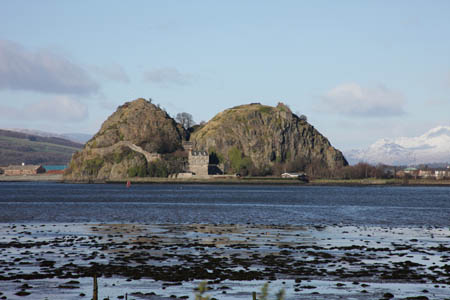
Dumbarton Rock, the 'Rock of the Clyde' that gave its name to the kingdom of Alt Clut.
By 632, the kingdom of Elmet had fallen to the resurgent Bernician Angles. A small enclave managed to survive huddled along Alt Clut’s southern border but the northern Britons no doubt sighed in relief when the Northumbrians turned their attention to southwards expansion. However, the later history of Alt Clut was far from peaceful. There was major conflicts with Dal Riata in 642, 711, and 717. Oengus of Pictland led two campaigns to conquer Alt Clut in the eighth century but was beaten back each time. In 756, the Pictish king teamed up with Eadberht of Northumbria and launched a third attack which very nearly succeeded but both the Picts and the Northumrbrians were almost destroyed in a desperate reversal by Alt Clut. As well as these major events, there were likely numerous smaller battles as the big four northern kingdoms – Alt Clut, Bernicia, Dal Riata and Pictland – squabbled for overlordship of the small, nameless chiefdoms to the south and east.

Very little is heard of Alt Clut until the late ninth century, implying the kingdom enjoyed a period of relative peace. The only mention of Alt Clut in the texts concerns the burning of Dumbarton in 780, but by whom and for what reason are unknown. In 870, Alt Clut was besieged by ‘black pagans’, a Viking army led by Olaf the White and Ivarr the Boneless, Norse kings of Dublin. Dumbarton was destroyed, huge numbers of captives were taken as slaves and the last British king of Alt Clut, Arthgal, was executed. The ruling British dynasty of Alt Clut ended, and the kingdom became a semi-independent territory of the Scots, gradually becoming known as Strathclyde.