Showing posts with label England. Show all posts

Friday, 27 June 2014

Vortigern

Shrouded in legend, Vortigern is a shadowy and semi-mythical early British leader who existed in the first half of the fifth century. There are no contemporary records that have survived and what little we know of him comes from legend and semi-historical tracts written centuries after his death.

A twelfth century illustration showing Vortigern and Merlin watching two dragons battling beneath the King's castle in Wales.
Vortigern came to power sometime in the early fifth century, possibly as early as 425, or as late as 445. He is remembered in legend as the High-King of Britain, a position he achieved through treachery and murder. However, Gildas, a historian writing in the sixth century, merely writes that Vortigern was one of a council, perhaps a civitas leader or magistrate; less of a high-king and more of a first-among-equals. Of his early leadership, very little is mentioned. Some sources claim that he married Sevira, the daughter of Magnus Maximus and had three sons, named in the Historia Brittonum as Vortimer, Catigern and Pascent. Vortigern may also have been involved in a power struggle with Ambrosius Aurelianus, another powerful Romano-British leader, who he defeated in battle in c.437.

Vortigern is immortalised in legend as the man who, in 446, foolishly and shortsightedly invited the Saxon princes, Hengist and Horsa, to settle in Kent in return for protection. Employing one barbarian tribe to defend against another was a standard Roman practice and it worked. Pict and Scottish raids ceased and, for a while, the Britons and Saxons lived peacefully.  Exactly where the mercenaries settled is uncertain; legend has it that they settled on the Isle of Thanet while Gildas rather vaguely mentions that they settled someone in the east. Some years later, the Saxons revolted. The reasons are unknown. Traditionally, Vortigern, drunk at a celebratory feast, fell deeply in love with Rowena, Hengist’s daughter. He promised Hengist whatever he wanted in exchange for her hand in marriage. The Kingdom of Kent was Hengist’s price and Vortigern agreed. Understandably, it was the British who revolted, overthrew Vortigern and put his eldest son, Vortimer, on the throne and battled against the Saxons. Gildas, on the other hand, writes that the Saxons revolted over a disagreement over payment. Yet another version claims that Hengist, realising how poor the British defences were, decided to take the opportunity and seize Kent for himself.

Vortigern’s last mention in the Anglo-Saxon Chronicle was in 455. It’s likely his kingship effectively ended with the Saxon revolt. Whether he died or disappeared is unknown. Legend says that Vortigern fought alongside his sons and was betrayed yet again at the Night of the Long Knives, a peace conference where the Saxons murdered the British in cold blood and forced Vortigern to surrender the kingdoms of Essex and Sussex in return for his life. Vortigern then fled to his powerbase in Powys where he was killed by Ambrosius Aurelianus. His two eldest sons, Vortimer and Catigern, died fighting the Saxons while his third son, Pascent, is named as an early ancestor of the Kings of Powys. 

Thursday, 26 June 2014

Caer Celemion

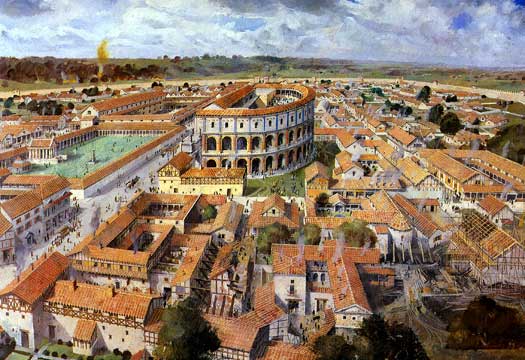
Caer Celemion was a sub-Roman British kingdom centred on the Roman town of Calleva Atrebatum. Starting life as an Iron Age hill fort, Calleva Atrebatum was founded soon after the Roman Conquest of 43AD as the civitas, or capital, of the Atrebates tribe whose territory encompassed parts of northern Hampshire, Berkshire and Wiltshire. Archaeological evidence suggests that Calleva Atrebatum was a thriving town with stone city walls, a bathhouse, an amphitheatre, temples and even an early Christian Church.

As Calleva Atrebtaum may have looked in its Roman heyday
The town avoided the general decline that affected other Romano-British settlements after the Roman withdrawal and continued to prosper well into the fifth century. As with other Romano-British territories at this time, Calleva Atrebatum and its surrounding area gained autonomy as British central authority weakened and by the mid-fifth century had emerged as an independent British kingdom.

As a British kingdom, Caer Celemion lasted for just over two centuries. Saxon settlers advancing along the Thames Valley frequently encroached on its northern borders and defensive earthworks were quickly thrown up to protect the kingdom. By the sixth century, Caer Celemion faced a new threat: the West Saxons who, having consolidated control over their Hampshire heartland, were looking to expand. Caer Gwinntguic fell in 552 and, two decades later, Caer Gloui also fell, swiftly followed by its sister kingdoms of Caer Baddon and Caer Ceri. By the dying days of the sixth century, Caer Celemion stood alone, isolated and totally surrounded by Saxon chiefdoms.

Map showing Caer Celemion and its neighbours in the early fifth century. By the end of the sixth century, Rhegin, Caer Gwinntguic, Caer Baddon, Caer Gloui and Caer Ceri had all fallen leaving Caer Celemion isolated and vulnerable.
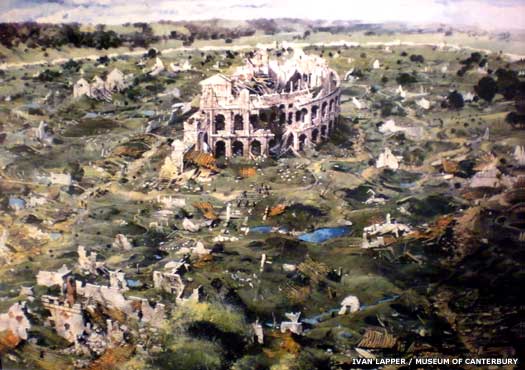
Inevitably, after holding out for almost three decades, Caer Celemion finally fell to Caewlin of Wessex in c.605. Calleva Atrebatum was abandoned, the ruins were ritually cursed, and its wells were filled to prevent any Romano-British occupants from returning. Unusually, the town was never resettled, with the West Saxons choosing instead to maintain their existing towns of Winchester and Dorchester. The ruins of Calleva Atrebatum can still be seen today.

Friday, 23 May 2014

Constantine of Cornwall (c.435 - c.443)

Constantine was a king of Dumnonia in the early fifth century. A later king of the same name also ruled Dumnonia in the mid-fifth century and picking the two lives apart has led to a great deal of uncertainty and confusion in the sources. How a king of Dumnonia gained a Cornish epithet is unclear. It may suggest that the royal family emerged from Cornwall or that Constantine was the man who brought Cornwall securely under the control of Dumnonia.

Born in c.411, Constantine succeeded his father, Conomor, in or around 435. From the few sources available, his reign appears to have been stable and uneventful. Dumnonia proved to be fiercely resistant to direct Roman rule and the Romans chose instead to manage it as a semi-independent province rather than occupy it militarily. Consequently, Dumnonia established itself as an independent kingdom with a strong and legitimate leader very soon after the Roman withdrawal. Also, being so far west, Dumnonia was not yet threatened by Saxon advances.

From the Welsh genealogies, Constantine appears to have had a brother, Dunstan, of whom very little is known and at least three sons. On his death in c.443, following Celtic tradition, his kingdom was divided between two of his sons. The eldest, Erbin, inherited the main kingdom of Dumnonia while his younger brother, Merion, ruled as a sub-king in Cornubia. The fate of the middle son, Digain, is unknown. Through Erbin, Constantine is recorded as the grandfather of Geraint, a later King of Dumnonia and an important character in Arthurian folklore.

Wednesday, 21 May 2014

The Middle Saxons / Middel Seaxe

Throughout the fifth century, bands of Saxons migrated across the North Sea from their homeland in northern Germany to the vulnerable shores of Kent. Along with bands of Thames Valley Saxons, the Middle Saxons moved up the Thames Valley but stopped at Londinium and settled to the north and west of the city. Londinium had been largely abandoned by the British and would remain so until the seventh century but the new settlers must have been a threatening presence for the British enclave of Caer Mincip.

Unlike their neighbours, the Middle Saxons never formed a lasting, cohesive kingdom. Instead they appear to have been a confederation of related but independent smaller Saxon groups who occupied an undefined territory (Middlesex) sandwiched between the West Saxons, the East Saxons, Kent and the Suther-ge. Northwards expansion was restricted by the British of Caer Mincip, who fended off the invaders until its collapse in the late sixth century.

Many of the early Middle Saxons came from Kent and were probably originally laeti employed by the British to defend Kent against Pictish and Irish raiders. It’s likely that these laeti took part in Hengist’s successful conquest of Kent in 455 - 457 and the Middle Saxons remained under Kentish influence for the next century and a half. Like the rest of the Saxon kingdoms, the Middle Saxons were severely weakened by the defeat at Mons Badonicus; most probably the reason for the continued survival of the British enclaves of Caer Mincip and Cynwidion. Kent’s power waned throughout the second half of the sixth century and the Middle Saxons, along with the Suther-ge, fell under East Saxon dominance by 600. By 730, the East Saxons lost control of the Middle Saxons to Mercia and any independence the Middle Saxons may have managed to hold on to was lost.

Wednesday, 7 May 2014

St. Erbin of Dumnonia (c.443 - c.480)

Born around 427, Erbin was a son of Constantine of Cornwall. After his father’s death in c.443, his kingdom was divided between two of his sons, an entirely normal practice in Celtic Britain. As the eldest son, Erbin became king of Dumnonia while his younger brother, Merion, ruled the sub-kingdom of Cornwall. Welsh genealogies list a third brother, Digain, but very little is known about him and it is entirely possible that he died as a young man.

Very little is known about his reign and, from the lack of mentions in any later sources, its presumed that it was largely peaceful and uneventful. Erbin had at least one son, Geraint, an important character in Arthurian folklore and Erbin’s successor following his death in c.480. According to some legends, he was also the father of Guinevere, the wife of King Arthur. As Geraint’s father, Erbin is mentioned in Geraint and Enid, a romance in the Mabinogion, a collection of medieval Welsh manuscripts. He is also listed as a saint in Welsh genealogies and is traditionally associated with Erbistock in Denbighshire. His feast day is 13 January.

Saturday, 3 May 2014

Hengist & Horsa

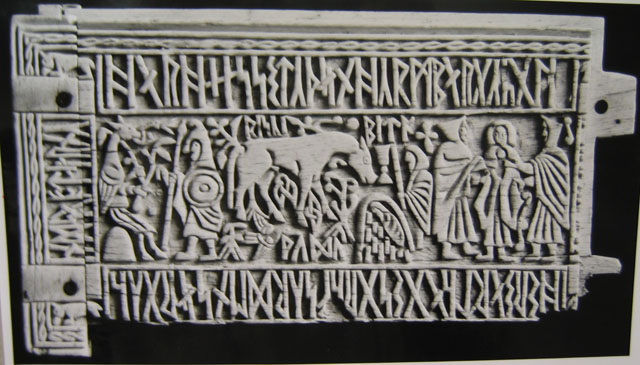
Hengist and Horsa were two early and semi-historical Anglo-Saxon chieftains who arrived in Britain in the mid-fifth century. After the Roman legions abandoned Britain at the beginning of the fifth century, the island was left vulnerable to invasion. Saxon pirates attacked from the east, the Picts and Scotti poured over Hadrian's Wall and the Irish raided along the west coast. It was not a good time to be Romano-British; cities were sacked and civilians were raped, murdered and enslaved as bands of marauders fought and pillaged their way across Britain.

An 8th century carving from Northumbria. The carving shows Hengist (represented as a stallion) grieving over the burial mound of his brother, Horsa. 
By the middle of the fifth century, the Romano-British had had enough. In 449, probably out of desperation, King Vortigern, along with his council of nobles, invited a pair of Saxon princes, Hengist and Horsa, to bring their men over to Britain and fight off the raiders in return for booty and land. This tried and tested Roman strategy worked. The Jutish mercenaries fought off the raiders and settled somewhere, either on the Isle of Thanet (unlikely) or somewhere along the east coast. Some time later Hengist and Horsa began a hostile takeover of Kent. Traditionally, this started with Hengist's daughter, Rowena, seducing the drunken Vortigern at a feast. Madly in love, the king promises Hengist anything he desires in return for his daughter's hand. Hengist's price was Kent. Understandably annoyed, Vortigern's son, Vortimer, deposed his father and raised an army against the Saxons. Historically, its more likely that either there was a disagreement over payment, or, seeing how weak the British defences were, the brothers got greedy.

After a few skirmishes, Hengist's mercenaries defeated Vortimer's men at Aeglesthrep (probably Aylesford). The Anglo-Saxon Chronicle records four battles in all. The results are not recorded but the geographical sequence suggests a Saxon retreat with the last battle fought at Wippedesfloet where, twenty years earlier, the brothers had first landed. Horsa died during this time, presumably in battle, as did Vortimer and his younger brother, Catigern. At some point during this period, the legend goes on to tell of the Night of the Long Knives. Hengist invited Vortigern and his men to make peace but in the midst of the feast, the Saxons massacred the Britons in cold blood. The only survivor was Vortigern himself who, chained and imprisoned, was forced to give up his lands to Hengist. Hengist ruled as King of Kent until his death in 488. His son, Oisc, succeeded to the throne.

As always with early Anglo-Saxon history, its difficult to untangle fact from legend. Hengist and Horsa are probably mythical figures but their story is likely based in fact. A Jutish chief did arrive in Kent in the fifth century. He and his men did serve a British king and they did revolt, fighting several battles against the Britons and gaining the British kingdom of Kent. There is no direct evidence that the Night of the Long Knives happened but the tale is preserved in ancient bardic songs so there may be a kernel of truth in there somewhere.

Monday, 14 April 2014

Elafius of Caer Gwinntguic (fl. 446 - 447)

Mentioned in Bede's History, Elafius was a British chieftain in the 440s and most likely a leader of the short-lived kingdom of Caer Gwinntguic. He is said to have had a crippled son who was miraculously cured by a visiting missionary, St. Germanus of Auxerre, in c.446.

Bede recorded the events as follows:

"...the wicked spirits, flying over the whole island, were reluctantly compelled to announce to the inhabitants the arrival of St. Germanus. Upon which Elafius, one of the principal men of the country, hastened to meet the holy men, taking with him his son, who, though in the flower of youth, was afflicted with such debility and lameness, as would have moved anyone to compassion to behold him: for the sinews of his legs were so contracted that he could not walk, nor even put his feet to the ground. An immense number of people followed this Elafius, and assembled round the holy prelates...

...Elafius cast himself at the feet of the Missioners, presenting to them his son ... the blessed Germanus ordered the youth to sit down, and, applying his healing hand to the part affected, gently drew it over it, when immediately the contracted sinews were relaxed, and restored to their proper tone, and the young man was presented to his father perfectly cured."

According to Bede, the miracle proved to Elafius that Catholicism was the one true faith, not Pelagianism (a branch of Christianity that rejected the idea of original sin and deemed heretical by the Catholic Church). Whether the events recorded by Bede really happened or not, Elafius and his people converted and shortly afterwards Pelegain preachers were exiled from the kingdom.

Sunday, 13 April 2014

Bernaccia / Bryneich

Bernaccia was a British kingdom that was created as part of the division of the Old North after the death of Coel Hen in c.420. With its capitals at Cataractonium (Catterick) and Corstopitum (Corbridge), the kingdom stretched east of the Pennines from the River Tees to north of Hadrian’s Wall. The Britons of Bernaccia were descendants of the southern Votadini tribes and presumably enjoyed peaceful relations with the northern Votadini in Goutodin.

Not much is known about the kingdoms of the North at this time, and Bernaccia is no exception. Its first king is recorded as Gorbanian / Germanianus, a younger son of Coel Hen. Later kings and events are mostly remembered in Welsh myth; many of the tales told about the Old North probably have a basis in truth but they are highly embellished and it is difficult to unpick fact from fiction.

Archaeological evidence suggests that laeti from Angeln were settled along the coast and Hadrian’s Wall by the early fifth century, presumably employed to protect the kingdom from Pictish and Germanic raiders in the dark days of Sub-Roman Britain. In 547, a century after the laeti revolt in Southern Britain, the Bernaccian Angles, led by a warrior named as Ida, revolted and seized the kingdom, kicking out the young king in the process. Morcant Bulc, the last British king of Bernaccia, fled north to Goutodin. Led by Morcant Bulc, a confederation of British kings from North Rheged, Elmet and Alt Clut attempted to retake Bernaccia in 590. They almost succeeded but the assassination of King Urien of Rheged (probably ordered by Morcant Bulc) fatally weakened the British cause and the confederation fell apart. Morcant Bulc died soon after and with him died the British kingdom of Bernaccia. The Anglian settlers called their new kingdom Bernicia and would in time unite with their southern neighbours, Deira, to form the powerful Anglo-Saxon kingdom of Northumbria.

Saturday, 12 April 2014

Coel Hen (c.350 - c.420)

Named in Celtic tradition as the High King of Northern Britain, Coel Hen is a prominent figure in many ancient genealogies. Many of the kingdoms of northern Britain and Wales were ruled by his descendants and he is preserved in legend as the founding ancestor of the Men of the North.

With the fading of central Roman administration in the early fifth century, regional governors known as dux were appointed to manage the protection of the island in the face of increasing barbarian raids. Brittania Secunda, the province of northern Britain, was placed into the care of a man named in the genealogies as Coel Hen – Cole the Old. From his headquarters in Ebrauc (York), Coel ruled a huge area of the north which stretched from Ebrauc to Hadrian’s Wall and possibly even beyond into the territory of Goutodin. Very little is known of Coel Hen personally but he must have been a charismatic and determined leader as he managed to turn northern Britain from a province which looked to Rome for its defence to an independent kingdom capable of defending itself.

Coel’s efforts meant that he was regarded as the first King of the North and he is familiar to many of us as Old King Cole from the nursery rhyme. Coel died in around 420 and his death is preserved in Welsh legend. The story goes that during Coel’s time as High King, Scotti settlers from Ulster had settled on the western coast of Pictland. Concerned that the Picts and Scots would join forces against the British, Coel sent raiders across his northern borders to stir up trouble between them. Coel’s ruse didn’t fool anyone and the Picts and the Scots retaliated by attacking Alt Clut. Enraged, Coel and his army stormed north and the Picts and the Scots fled into the hills. Flushed with victory, Coel chased after them and set up camp in what is now Ayrshire. Sometime later, starving and desperate, the Picts and Scots advanced in an all-or-nothing attack on Coel’s stronghold. Taken by surprise, Coel and the northern British scattered in panic. Coel wandered through the unfamiliar countryside of Argyll until he fell into a bog and drowned – an inglorious end for the first High King of Northern Britain.

Mention of Coel Hen in the Y Commrodor genealogy
On his death, Coel’s kingdom was divided between his two sons with the eldest, Ceneu, taking Ebrauc and his youngest, Gorbanian, inheriting Bernaccia. His daughter, Gwawl, had been married off to Cunedda Wledig and the pair had founded a kingdom and spawned several royal dynasties of their own in North Wales. His descendants, the northern British and Welsh kings of the sixth century, would stubbornly resist Teutonic invasion until their calamitous defeat at the Battle of Catreath in 597.

Friday, 11 April 2014

Durovernum Cantiacorum

Originally an Iron Age hill fort, Durovernum was a town in the Roman province of Britannia which existed for a period of four hundred years from the time of the Roman Conquest until the arrival of Hengist and Horsa in the mid-fifth century.

Durovernum was founded as a Roman fort in 43 AD, very soon after the conquest, to guard a crossing of the River Stour. Military occupation of the site lasted until 60 AD. After demilitarisation, Durovernum became the civitas capital of the Cantii, a Celtic tribe who inhabited most of modern day Kent. The short period of militarisation and the very early date for the founding of Durovernum (one of the earliest in Britain) reflects the largely pro-Roman attitudes found at that time among the Cantii.

With a strategic position on Watling Street, Durovernum was a prosperous and thriving Roman town. As a civitas, the town would have had a forum, a basilica, temples, a theatre and public baths. The exact locations of many of these buildings are unknown, buried as they are under modern day Canterbury. In the late third century, to defend against barbarian raids, stone walls and a large earth bank were constructed around the town.

Durovernum Cantiacorum in its Roman heyday...
After the Roman withdrawal in around 410, the Romano-British inhabitants of many civitas capitals in Britain attempted to carry on as normal and Durovernum was no exception. It’s not known if Ceint became a true kingdom in its own right in the early fifth century, or if it was a semi-independent province governed by a Roman-style magistrate. Whichever the case, Ceint’s increasing vulnerability to barbarian raids meant Saxon laeti were quickly hired to protect Durovernum in return for land outside of the city walls.

In the 440s, the Romano-Britons of Ceint were hit by a double-whammy; firstly a plague swept across southern Britain in 446; secondly there was laeti revolt soon after in which many of the Saxon and Jutish mercenaries settled around Ceint joined a Germanic army of invaders led by Hengist and Horsa. Chaos ruled across south-east Britain and Durovernum fell in 457.

...and Durovernum Cantiacorum in the fifth century. The few inhabitants that remained likely lived in wooden houses among the ruins.
However, despite Hengist’s hostile takeover of Ceint, Durovernum was not completely abandoned. It seems to still have been a sizable settlement although life for the Romano-British inhabitants must have been very different. The Roman buildings and roads quickly fell into disrepair as urban life was abandoned and the people of Durovernum reverted to subsistence farming. The town would later be revived by Jutish settlers who would rename it Cantwaraburh. Over time Cantwaraburh would become Canterbury.

Saturday, 5 April 2014

Caer Gloui

Founded by the Romans as Glevum, Caer Gloui was a Romano-British city which would eventually become modern day Gloucester. The city served first as the powerbase for Vortigern in the early fifth century and then as the stronghold of Ambrosius Aurelianus in the battles against the Saxons. Caer Gloui and its sister cities of Caer Baddon and Caer Ceri held out against Saxon advances for over a century but eventually fell to the West Seaxe in 577.

From 420 onwards, Caer Gloui was ruled by semi-independent magistrates, likely Romano-British nobility who gradually gained more autonomy as British central power weakened. Plague and a laeti revolt in the east meant that by the middle of the fifth century, central British authority had collapsed entirely. The magistrate of Caer Gloui, his name lost to history, now commanded much of the area around the Severn Estuary, including the cities of Caer Baddon and Caer Ceri. It is entirely possibly but also completely theoretical that this magistrate was the father of Ambrosius Aurelianus, a later Romano-British king of the region. The name of this territory has also been lost to history but it does appear to have been a cohesive political entity until the mid-fifth century.

Map showing Caer Baddon, Caer Ceri and Caer Gloui. In the mid-sixth century they become separate kingdoms but before that they would have been a single territory administered from Caer Gloui.
In 495, the Britons of Caer Gloui fought and defeated an Anglo-Saxon army led by Aelle of the Suth Seaxe in what proved to be a pivotal battle at Mons Badonicus. Defensive dykes constructed in the mid-fifth century likely channelled the invaders towards Caer Baddon where they were slaughtered in huge numbers. Not surprisingly, the various bands of Saxons, Angle and Jutes that made up Aelle’s army were severely weakened by the defeat and the British won themselves two generations of peace. The aftermath of the battle saw modest increases in the population of Caer Gloui although all of the new building was in wood and large parts of the city had long fallen into disuse.

By the mid-sixth century, the larger territory of Caer Gloui had been split into three kingdoms, probably due to the Celtic practice of dividing a kingdom between sons. This indicates a change from Romanised magistrate rule to true kingship. The three cities, however, remained closely allied and in 556 they fought an army of West Seaxe at Beran byrg (modern day Barbury Castle, near Swindon). The result is unrecorded in the Anglo-Saxon texts so it’s likely it was a British victory.

The British of the three cities and the West Seaxe under Ceawlin met again at the Battle of Deorham in 577. Despite receiving military support from the western kingdoms of Dumnonia and Glastenning, the British were defeated. Caer Gloui’s last king, Conmail, was killed, as were the kings of Caer Baddon and Caer Ceri. Caer Gloui was the last of the three cities to fall, but fall it did. The defeat was a disaster for the British. Gwent and Pengwern were separated from Dumnonia and the already beleaguered Caer Celemion was suddenly exposed on all sides.

The territory was quickly settled by the Hwicce, a mixed band of Angles and Saxons who appear to have merged with the remaining British population. British Christianity certainly survived the influx and it has been suggested that the Hwicce ruled over the Britons rather than eradicating them. The Hwicce who settled around Caer Gloui kept the city’s name but corrupted it into Gleawanceaster. Over time the name would evolve further to become Gloucester.

Friday, 4 April 2014

Caer Baddon

Better known by its Roman name of Aqua Sulis, Caer Baddon was a late Romano-British city which would in time become the modern city of Bath. In the early fourth century, the city remained under British central administration but, by 430, Caer Baddon was under the control of the magistrates of Caer Gloui. During this time, it’s likely the British inhabitants of Caer Baddon attempted to maintain an urban Romanised lifestyle but there must have been an inevitable, if slow, decline. The great bath complex eventually fell into disuse although the Britons continued to enjoy the hot springs.

In the early 440s, the city’s Roman defences were repaired but this would be prove to be too little, too late. A serious plague hit southern Britain in 446 and Saxon laeti across the country revolted. Raiders roamed across Britain in a violent free-for-all and attacked any residents who remained. The chaos in Caer Baddon is perhaps best illustrated by the discovery of a severed skull of a young child found in an oven of a Roman townhouse in the city.

The chaos reaches its zenith when Aelle and his confederation of Angles, Jutes and Saxons marched west in 496. The Britons and invaders clashed at the Battle of Mons Badonicus which, although the exact location is unknown, was likely fought at or near Caer Baddon. The British claimed a decisive victory, and secured themselves two generations of peace.

Badbury Rings, in Dorset - a possible location for the Battle of Mons Badonicus
In the mid-sixth century, the single territory of Caer Gloui was split into three kingdoms, of which Caer Baddon was one. This probably reflected a Celtic practice of dividing a kingdom between sons; an interesting shift from the previous Roman-style administration. The city was protected to the south-west by the Wansdyke, a huge earthwork constructed either in anticipation of the Battle of Mons Badonicus, or just after. However, the West Seaxe under Ceawlin managed to break through in 577 and, despite military support from Glastenning and Dumnonia, the British were defeated at the Battle of Deorham. Caer Baddon’s last king, Farinmail, was killed fighting the West Seaxe, as were the kings of Caer Ceri and Caer Gloui.

The defeat was a disaster for the British. Caer Baddon fell to the West Seaxe, swiftly followed by Caer Ceri and Caer Gloui. Caer Celemion was exposed on all sides and the British kingdoms of Gwent and Pengwern were separated from Dumnonia in the west. The kingdoms of Dumnonia and Glastenning, safe behind the Wansdyke, kept hold of what they could of Caer Baddon’s territory but the remainder was quickly settled by Angles, who migrated into the northern parts of the kingdom, and Saxons, who settled around Gloucester and Bath. The Saxons kept the city name but corrupted it to Bathanceaster. It remained an important religious site and a Saxon monastery was founded in the city in the seventh century. The Saxon and Angle settlers became collectively known as the Hwicce.

Thursday, 3 April 2014

Caer Gwinntguic

A very early fifth century British kingdom, Caer Gwinntguic evolved from the pre-Roman territory of the Belgae tribe. Centred on the Roman town of Venta Belgarum, the kingdom was tasked with defending the westernmost section of the Saxon Shore. In the face of increasing barbarian raids, laeti from North Germany, most likely Saxons, were settled along the south coast. Meonware Jutes also settled along the coast, potentially threatening the kingdom’s southern borders, but peaceful relations appear to have been quickly established. Of greater concern was Aelle and the Suth Seaxe who had landed on the south coast in 477.

From its very beginnings, Caer Gwinntguic was on a defensive footing, likely due to the collapse of Rhegin to the southeast, the expansion of the Suth Seaxe and the emerging West Seaxe kingdom under Cerdic. In the mid-fifth century, there was a widespread laeti revolt, triggered by a plague that swept across southern Britain and a vicious power struggle within the British administration. However, it seems that many of the laeti of Caer Gwinntguic remained loyal and fought alongside their Romano-British neighbours right up until the kingdom’s dying days in the late sixth century. As a result, the archaeology of Caer Gwinntguic reveals a blend of cultures and people, perhaps best illustrated by the kingdom’s name itself; ‘Gwinntguic’ is likely a Saxon corruption of a Celtic name which was later adopted by the British.

In 508, the Saxon and Romano-British warriors of Caer Gwinntguic were led by a chief by the name of Natanlaod to meet the West Seaxe in battle somewhere near Southampton Water. Cerdic’s West Seaxe took victory and, as a result, Caer Gwinntguic was completely isolated from the south coast it was supposed to protect. Fifty years later, the kingdom fell to the West Seaxe, leaving its northern neighbour, Caer Celemion, exposed and vulnerable. The city of Venta Belgarum was not fully abandoned, however, and it is likely that a small number of surviving Saxon laeti and Romano-Britons eked out a living in the ruins. Perhaps because it was not fully abandoned, Venta Belgarum would later be revived as Wintanceastre, the capital of Wessex.

Wednesday, 2 April 2014

Thames Valley Saxons

The Thames Valley Saxons were some of the first Saxon groups to arrive in England but the efforts of these early settlers have gone largely unrecorded. Archaeological evidence suggests that by the start of the fifth century, small groups of Saxons had settled in the Thames Valley, probably employed as laeti to defend the borders of the various British territories which had sprung up in the region. Pagan cemeteries found at the confluence of the Thames and Kennet rivers, dating to the late fifth century, give testament to this very early Saxon settlement. In many ways the Thames Valley Saxons were trailblazers and many later settlers would follow in their footsteps

It appears that the Saxon laeti remained loyal to their Romano-British masters until around 440 AD. Some laeti, such as those in Caer Gwinntguic, remained loyal and threw in their lot with the native British population. Others, however, started to carve out their own chiefdoms in the Thames Valley as British influence weakened in the face of a plague which swept across southern Britain in the mid-fifth century. Bands of Thames Valley Saxons were threatening the northern border of Caer Celemion by 470 and twenty years later were starting to encroach on the territory of Cynwidion. By the end of the fifth century, Thames Valley Saxons had wrested control of the Upper Thames Valley from the Britons.

A map showing the Thames Valley. The Thames Valley Saxons would have migrated from east to west, as would many other later settlers.
As Aelle, King of the Suth Seaxe and Bretwalda, marched northwards along the Thames Valley to do battle with the Britons at Caer Baddon, it is very likely that bands of Thames Valley Saxons were involved in the heavy defeat at Mons Badonicus in 496. It is also very likely that the Thames Valley Saxons, along with the Suth Seaxe and Cantware, were severely weakened in the aftermath of the battle and there were no more major Saxon advances for a generation. Instead, the British may have actually regained part of the Thames Valley although they didn't keep hold of any regained land for long.

By the mid-sixth century, the Thames Valley Saxons appear to have recovered sufficiently to pose a threat to both the Romano-Britons of Caer Celemion and Caer Ceri and the West Seaxe. At that time, Ceawlin of the West Seaxe led a series of campaigns along the Thames Valley but it was his successors, Ceol and Ceolwulf, who established firm control. By 592, any independence the Thames Valley Saxons once had was gone.

It has been suggested that the Thames Valley Saxons who migrated westwards may have become the Gewisse, a mixed Saxon and Angle tribe who settled around Gloucestershire and Worcestershire. In time the Gewisse became the very first West Saxons. This, however, remains nothing more than a theory.

Tuesday, 1 April 2014

Venta Belgarum

Established in 70 AD on the site of an abandoned Iron Age hill fort, Venta Belgarum was the civitas of the Celtic Belgae tribe whose territory covered much of modern-day Hampshire. Venta Belgarum was a thriving and prosperous Romano-British town.  A defensive earth bank and ditch encircled the city by the second century, and stone city walls were erected a century later. Excavations have shown that Venta Belgarum had many fine Roman townhouses complete with mosaics, large public buildings and temples dedicated to the Roman gods Jupiter, Juno and Minerva as well as the Celtic horse goddess, Epona. Outside of the city walls were extensive suburbs and two large Romano-British cemeteries to the north and east.

Mosaic floor from a nearby Roman villa
Venta Belgarum did not escape the general decline suffered by Roman Britain in the fourth century. Houses started to fall into disrepair and the drainage system collapsed.  Testament to the increasing threat of raids by Germanic war bands, the city’s defences were strengthened and there is archaeological evidence of laeti, South German mercenaries who helped defend Venta Belgarum in return for land outside the city.
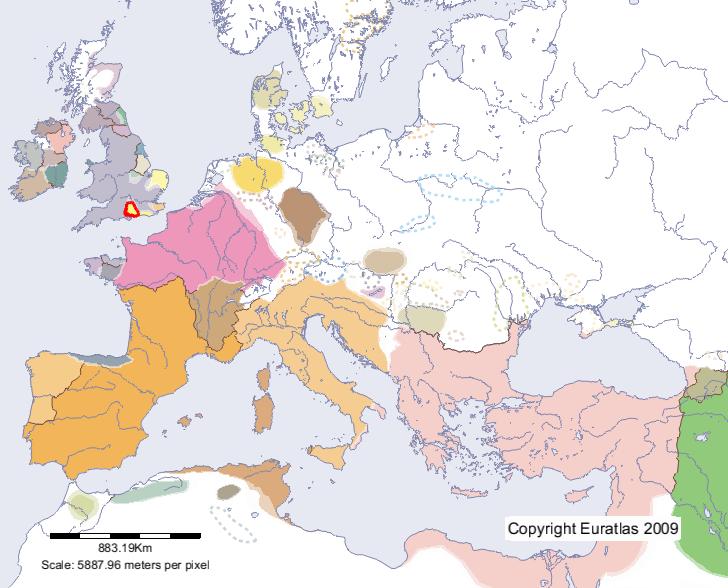
By the early fifth century, Venta Belgarum had become the regional capital of Caer Gwinntguic, a sub-Roman British kingdom tasked with defending the westernmost portion of the Saxon Shore. The 420s and 430s saw a second settlement of laeti, this time from North Germany and almost certainly Saxons. Jutish settlement on the eastern side of Southampton Water posed a potential threat but peaceful relations were quickly established, possibly due to the newcomers’ integration with long-settled laeti.

Map of Europe in 500 AD. Venta Belgarum / Caer Gwinntguic is outlined in red.
By 477, the arrival of Saxon settlers under Aelle at Selsey in modern day West Sussex had largely cut off Venta Belgarum from the south coast. The city’s population had dwindled and economic activity had all but ceased. Over the next fifty years, the few inhabitants of Venta Belgarum must have developed a siege-like mentality in the face of Saxon encroachment from the east. The city’s south gate was blocked in two stages, probably in response to the founding of a nascent West Saxon kingdom under Cerdic, an act that likely forced Cerdic to advance instead towards the less well-defended West Country.

By the early 6th century, Venta Belgarum was very isolated indeed. Rhegin to the south-east had fallen to Aelle of the Suth Seaxe and it was cut off from Dumnonia in the west. The remaining population was likely made up of equal amounts of Romano-Britons and Saxon laeti who, having been settled in Britain for several generations, had more in common with the native population than the invaders.

In 508, the Romano-Britons of Caer Gwinntguic were defeated in battle by the West Seaxe under Cerdic and became completely cut off from the south coast. Fifty years later the kingdom collapsed and the city itself fell to the West Seaxe. The population dwindled even further but it's thought that Venta Belgarum was not fully abandoned. The few Saxon descendents of long-ago laeti probably remained, as did any surviving Romano-Britons. Probably because the city was never fully abandoned, it was revived in the late 6th century and became known as Wintanceastre, capital of the West Seaxe kingdom.